
TRAINING AND SIMULATION
I/ITSEC NEWS: F-35 Program Office Fielding New Simulators for Mission Training
12/4/2025
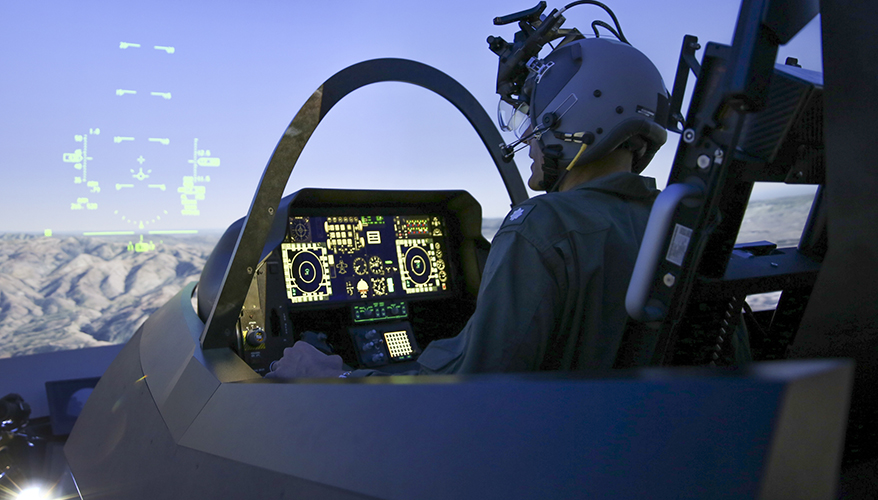
Defense Dept. photo
ORLANDO, Florida — The nature of aircraft pilot training is evolving, and the office overseeing the F-35 Joint Strike Fighter is pivoting to simulators that help aircrews prepare for specific missions.Pilot training is in the middle of a major transformation — previously, when a trainee stepped into a simulator, “their job was basically learn how to fly the airplane, learn how to take off, learn how to deal with an emergency and then not die coming home,” said Navy Capt. James Rorer, program director for training systems and simulation in the F-35 Joint Program Office.
“That has totally changed, where we are really focused now on actual training for specific missions,” Rorer said during a panel discussion at the National Training and Simulation Association’s Interservice/Industry Training, Simulation and Education Conference Dec. 4.
For the F-35, it is partner nations who fly the aircraft that initiated this shift to mission-focused training, rather than the three U.S. services — Air Force, Navy and Marine Corps — that use it, he said.
“I've got customers that will only ever have 40 aircraft or only ever have 20 aircraft, and they've got to last the whole entire life of that air vehicle,” he said. “So, the only way these customers are going to get relevant training to do specific mission work … is through simulated training.” And simulation technology has advanced rapidly to meet the demand for mission-focused training, he noted.
For example, the Air Force and Navy manage the Joint Simulation Environment, or JSE, a facility used to conduct high-fidelity F-35 training. Rear Adm. Todd Evans, commander of the Naval Air Warfare Center Aircraft Division, said the system has broken the mold of a simulator’s perceived limitations.
“There's something about a simulator that you know you're not going to die, and so you will never get to that realism that you would in a real aircraft,” Evans said during a panel discussion at the conference Dec. 3. However, F-35 pilots don’t just need to learn how to aviate, navigate and communicate; they need to understand all of the weapons and sensors across the whole strike package and be able to coordinate them.
“What we do in JSE is put such a stressful cognitive load on those pilots that they forget they're in the simulator, and they actually come out scared,” Evans said. “That is kind of that fourth dimension of, how do you get to true simulation? And when you forget you're in the simulation, that's kind of how that happens.”
Along with full mission simulators like JSE, F-35 customers also want training systems for specific tasks, Rorer said. The aircraft’s designer, Lockheed Martin, is beginning to field the Modified Mission Rehearsal Trainer, which has a “smaller footprint, costs less, and it’s more designed towards a mission environment,” he said.
Along with practicing all the essentials like takeoff, landing and emergency procedures, “I can have multiples — tens, twenties — of these MMRTs available” on which to train for specific mission sets, he said.
The Naval Air Warfare Center Aircraft Division is also developing the F-35 Emulated Non-Operational Flight Program Interoperability Experience, or FENIX, another smaller footprint simulator allowing pilots to “go out and do things repetitively, over and over and over again, find where you make mistakes, go back, retrain, fix it, so that you can be capable to fight the fight that we need to fight,” Rorer said.
Capt. Jonathan Schiffelbein, program manager for naval aviation training systems and ranges, said there is also an effort underway to develop “light instantiations” of the Joint Simulation Environment that isn’t the “full suite of stuff, but it's enough stuff to get done what we need to get done.”
JSE isn’t a “box you deliver … it’s an environment that’s made up of certain components,” Schiffelbein said, so it takes some “figuring out how we’d move that, where we can move that.”
Along with new simulators, the Navy is pushing the F-35 program office to adopt more live-virtual-constructive training tools, Rorer said, and “the reason is, is because we do have embedded training within the F-35; the problem is is our embedded training doesn't talk with the F/A-18s, the Growlers, the E-2s and everybody else that the air wing has that they need to fly with.”
The Navy has pushed the program office “over the last year to make sure that we get that LVC working inside the aircraft so it can then conduct exercises as a unit, as an air wing, so that when they deploy, they already know what they're doing,” he said.
While “you can sit down in a simulator all day long and practice it and get that kind of realism, maybe even get some adrenaline rolling because you're facing threats that your mind now thinks are real … I still sort of need to feel what it feels like to pull that jet in a position to fight that bad guy,” and that’s why having the mix of live, virtual and constructive training is “so vitally important,” he said.
Topics: Training and Simulation
Comments (0)