
AIR FORCE NEWS
JUST IN: Air Force Leveraging AI for Advanced Wargaming
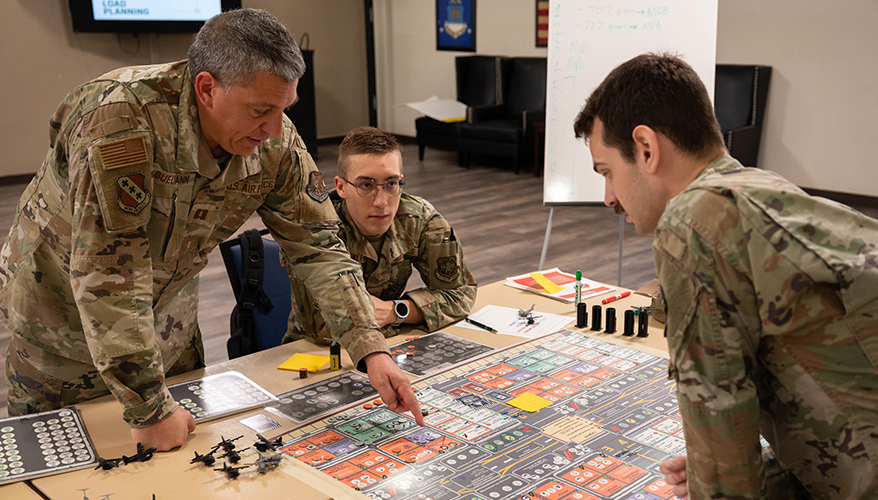
Air Force photo
WASHINGTON, D.C. — In its modernization quest to pursue system attributes over platforms, the Air Force is using advanced war gaming powered by artificial intelligence to help define exactly what it’s looking for.
Thomas Lawhead, assistant deputy chief of staff for strategy, integration and requirements for the Air Force, said the service is working on a concept called WarMatrix that brings an AI cloud-based system into its war-gaming capability.
“How do we define the attributes needed to win?” Lawhead said during a keynote speech at the APEX Defense conference Jan. 28. “The answer lies in our ability to leverage advanced war gaming.”
For decades, the service’s war gaming capability has been, “generally speaking, a six month to a year process of developing out the red and blue sides of any particular wargame and how it's all going to play,” he said. “What's the logistics side of this war game? What do we expect out of it? What are the blue forces? What are the red forces? How are they going to interact? Who's acting as white? Who's the referee? How are we going to adjudicate?”
Humans are going to adjudicate, he said, “so, it’s going to be a bunch of dudes and dudettes sitting around a table after each move, going, ‘Who won, who lost? How much did you win? How much did you lose? What forces do you have left?’”
The war game itself can last for weeks, he said. “And we’re able to get that fine, well-thought out, well-developed ‘Monte Carlo’ of one.”
The lessons learned in war gaming have been and continue to be invaluable, Lawhead said. “But in this day and age of machine learning and AI, it's not enough, and it's not fast enough.”
With WarMatrix, “Instead of months and months to prepare for these, we can digitally prepare for war games quickly,” he said. “We can, during the war game, have multiple excursions. We can adjudicate the war game itself. Instead of humans doing it, we can do it virtually, and we can start to tweak during the war game.”
The cloud-based system can make determinations such as how much or how little of a capability is used and determine key connections across multiple mission threads, he added.
The other piece of WarMatrix that is “critical to the entire enterprise is it's not going to be just a war gaming solution,” Lawhead said. The data that comes out of its war games will translate into the service's modeling and simulation efforts.
Currently, tactical units do not have a mission planning system that talks and lays out or simulates “tonight's mission,” he said. “This is readiness for tonight, right? So, if I'm in a squadron, I can jump on the mission planning system. I can develop my siloed mission plan, but I can't really play it out and simulate it across all of the other squadrons.”
“What we’re talking about is campaign planning at the tactical level,” he continued. “And that's what WarMatrix will enable us to do.” Getting advanced war gaming tools such as WarMatrix, that can provide an iterative engine to determine with confidence which capability attributes will give warfighters the “decisive edge tomorrow and into the future,” is “future work for us,” Lawhead said.
“Advanced war gaming allows us to embark in earnest on a risk taking, iterative cycle of rapid prototyping. We can figure out an idea that works. We can work with program offices, in the labs. We can in industry. We can build prototypes. We can test it. We can fly it. We can break it. We can fix it. And we can … move on into procurement and sustainment.”
Lawhead said the Air Force plans to expand WarMatrix to other services that are interested, noting that the Space Force and Marine Corps have already expressed interest.
“Frankly, I don't think that we have actually probed all the depths of where WarMatrix and our integration with our modeling and simulation community and our tactical mission planning community actually is going to lead us,” Lawhead said. “So, there is some wide open field there” and “we would like to continue to have these conversations with industry, with the other services.”
Topics: Training and Simulation
Comments (0)