
SHIPBUILDING
AI, Digital Twins Seen as Solution to Shipyard Backlogs
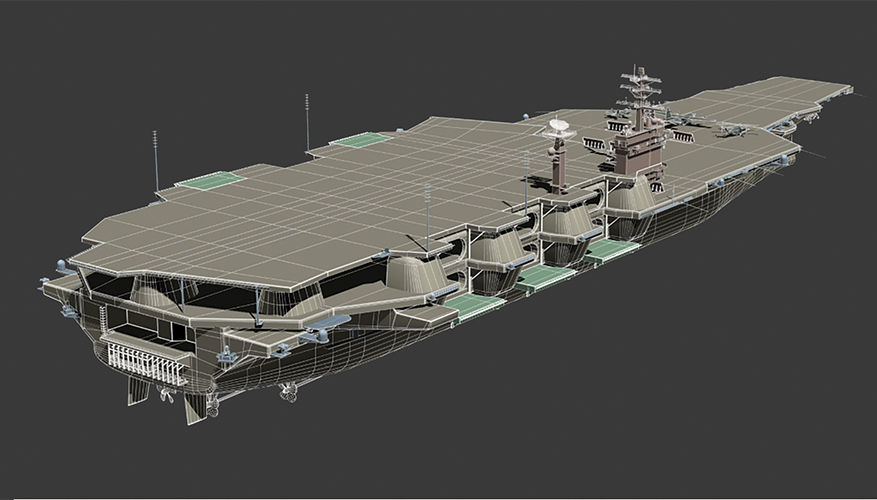
TurboSquid illustration
NATIONAL HARBOR, Maryland — The Defense Department and Navy are prioritizing rebuilding the nation’s struggling shipbuilding sector, and industry leaders think artificial intelligence and digital twins could help with ship maintenance.
The only way the United States can bolster its struggling shipbuilding industry and keep pace with China is to increase the use of artificial intelligence and digital twins to speed up maintenance and reduce backlogs, said Lucian Niemeyer, CEO of Building Cyber Security.
The U.S. shipbuilding industry has been plagued with problems for years, from workforce shortages and infrastructure and supply chain issues to backed-up maintenance depots and budget overruns.
Efforts are underway to change course. President Donald Trump in April issued an executive order, “Restoring America’s Maritime Dominance,” and in July signed into law the One Big Beautiful Bill Act, which included $29 billion in funding for shipbuilding and the maritime industrial base.
While U.S. shipbuilding has floundered, China has established itself as a dominant figure in the global industry, accounting for 53.3 percent of shipbuilding worldwide, while the United States makes up 0.1 percent, according to a March analysis by the Center for Strategic and International Studies.
The pacing threat China poses in the maritime sector makes restoring U.S. shipbuilding even more of a “gigantic priority,” Niemeyer said.
“There’s no way we’re going to keep pace with the Chinese when it comes to actually building and repairing ships,” he said during a panel discussion at the recent Defense TechConnect Innovation Summit and Expo.
The United States is behind in shipbuilding “across the board,” Niemeyer said. The nation is supposed to be generating 3.3 submarines per year, he said, but is only building 1.1, in addition to lagging on destroyer construction.
“The dream” is to have an AI-enabled digital twin — a virtual replica of a physical system updated in real time to reflect its real counterpart — that can tell operators and even predict exactly what the ship needs, Niemeyer said.
“You want AI to be able to scrape that supply chain to see basically what’s available today and what ultimately needs to be manufactured through unique casting,” he said. “That has to happen in real time. And you don’t necessarily need to have the humans in the loop on that.”
AI can “immediately” play a significant role in scheduling and timing, such as getting crucial parts to shipyards to speed up repair times, but also in evaluating what the cost over time looks like, Niemeyer said.
But artificial intelligence is only as good as its data. Quality data is crucial to successfully integrating artificial intelligence and automation into shipyard maintenance, said Mike Baker, chief technology officer at Sabel Systems.
“How do you take that information, turn it into capable, digital, quality information to be able to then feed into the AI, to be able to then produce that function on that operation set, to be able to give to the younger skill set who do not want paper?” Baker said during the panel discussion.
Utilizing AI and digital twins in shipyard maintenance could also help address the workforce shortage, and the Defense Department and commercial industry need to have an “honest discussion” about what can be done, Niemeyer said.
“How can we maximize output on the yards in the Northeast while also looking for other locations around the country that would allow us freely, without any concern, to start increasing the use of automation?” Baker said. “It’s a tough question to solve, because you don’t want to lose that labor force. On the other hand, automation can do a lot if it’s allowed to.”
The Navy is already using digital twins on the operational side, but the service must also leverage that capability to speed up ship maintenance, Niemeyer said.
Today, the Navy is using digital twins for shipbuilding and the F-35 Joint Strike Fighter program, Niemeyer said. What it needs is “a live performance platform that you can track virtually, that would then tie into AI and ultimately manage maintenance.”
Digital twins can be used to evaluate ships and directly tell the operators exactly what’s wrong with them and then transmit that information back to shore and to the supply chain, Niemeyer said.
The development and implementation of digital twins and data capture technologies allow the use of robotics and automation, “which is really important to maintaining the cadence that we need to build our ships,” said Scott Kasen, director of advanced technologies at shipbuilder Austal USA.
One of the reasons China’s shipbuilding dominance has increased is its military-civil fusion strategy. According to the CSIS analysis, China has combined commercial and military production in many shipyards, granting the People’s Liberation Army Navy access to commercial shipyard infrastructure, investment and intellectual property.
Similarly, the U.S. Navy needs to leverage existing commercial capabilities for military shipbuilding, said Jacques Jarman, chief growth and federal operations officer at edgeTI.
“The real thing that I would encourage people to think about as we look at all of these things we’ve been told by engineers over the years, … ‘You’ve got to design everything, you’ve got to get everything perfect and figure it out.’ Well, we don’t have the time for that,” he said during the panel. “More importantly, we have all the systems, and we have all the data. You need to just start stitching it together in the way you need it.”
Advanced digital twinning technology exists in industry, but integrating it into the Defense Department’s complex spectrum of existing capabilities poses challenges.
The Navy must figure out how to apply digital twins on individual vessels, “be able to make sure that when they come in, that you know what’s going on before they get there, and that you’ve got the work instructions digitally already enabled for that function before it even comes into the port,” Baker said. “And you can even potentially go out of the ship and fix it on the fly. Because you’ve got that digital twin, you know what’s going on before you get there.”
Additionally, the Navy must leverage existing AI tools and look at “getting that information and making it m
ore performative, from the prompt engineering, from AI, [so that] now, AI gives you the answer,” Jarman said.
“People are thinking of their task, ‘I want to replace that part.’ … AI is going to tell you all of those things, but it needs that information from all of the different systems,” he said. “The ship says what it needs, then all of these other systems behind it will drive it.”
Instead of building “big, monolithic systems” from the ground up, the Navy should leverage technology that will “integrate with all of the systems seamlessly that you already have, as opposed to, traditionally, let’s build a whole new system that does it better,” Jarman said. “And that’s a great idea, but it really hasn’t come to fruition. And the one thing that’s always going to happen every year is it’s going to get more complicated.”
While shifting the cultural mindset to embrace modern capabilities like AI and digital twins can be difficult, it is happening “very fast” in the shipbuilding industry, Kasen said.
“Shipyards are looking at new technologies and adopting those new technologies. … Those older yards are also taking public investments and also privately investing in the modernization of their technology,” he said. “It’s happening today, and it’s happening [at] a really unprecedented rate. I think shipbuilding in 10 years from now is going to look very, very different than it did five years ago.”
Additionally, it’s important to implement modern capabilities like AI and digital twins into maintenance for the younger workforce; they actually want to work with robots and automated technologies, Kasen said.
“The question is, what’s the future workforce? To me, it may end up being a robotic engineer or a robotic technician, as opposed to actually a welder or an electrician, so I think that’s what you might want to offer to the younger generations,” Niemeyer said. “OK, great. You don’t want to work on ships. You want to work on robots. Guess what? Robots are building ships.”
Niemeyer said communication between government, military, industry and the shipyard workforce is extremely important.
“We need to go back to the headquarters of the Navy and say, ‘This is what you’ve got to ask for,’” he said. “Bring the maintainers, bring the sustainers, bring the shipyard guys in saying, ‘Here’s what I want to see in a ship digital twin that ultimately I can use that to maintain lifecycle management for that.’ That doesn’t exist right now. That has to happen.” ND
Topics: Cyber
Comments (0)