
MODELING AND SIMULATION
Modeling and Simulation Could Strengthen Indo-Pacific Partnerships
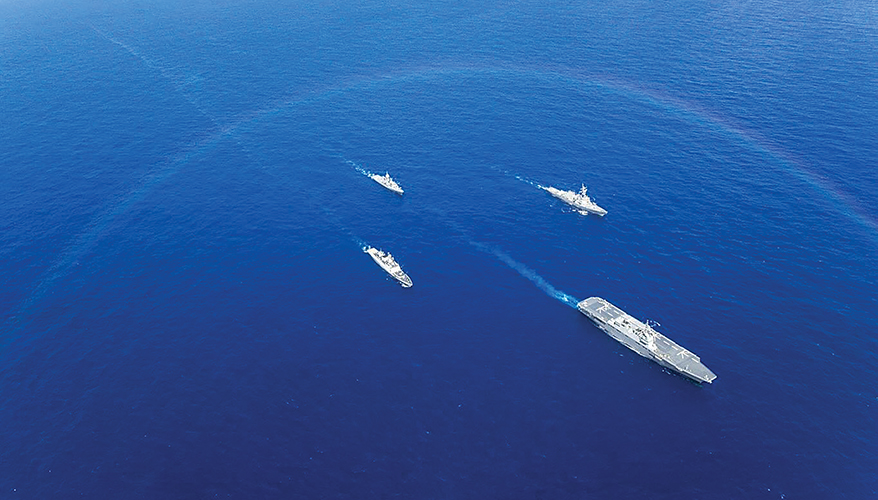 A Japanese helicopter destroyer, a U.S. Arleigh Burke-class destroyer, an Indian frigate and an Australian frigate participate in Exercise Malabar 25.
U.S. Indo-Pacific Command photo
ORLANDO, Florida — The vast region of the Indo-Pacific creates a complicated landscape for training among partners and allies, but modeling and simulation could be the connective tissue to help stitch together an increasingly collaborative presence.
Air Force Brig. Gen. Richard Goodman, director of joint training and exercises (J7), U.S. Indo-Pacific Command, characterized the region from a training perspective as “increasingly joint,” “increasingly connected” and "increasingly combined with partners.”
Warfighters in the first and second island chains “depend on these capabilities that you're developing and providing for their training, for the exercises, demonstrations and rehearsals that are occurring,” Goodman said during a panel at the National Training and Simulation Association’s recent Interservice/Industry Training, Simulation and Education Conference. “And they matter to the security of the Indo-Pacific.”
As important as collaborative training is to the Indo-Pacific, further complicating its geography is its politics.
“Every piece of terrain in the Indo-Pacific is part of a sovereign country that [has its] own sovereign requirements,” said Brig. Damian Hill, director general of the Joint Collective Training Branch at Australia’s Joint Operations Command.
“So, how do we bring them into our environment to enable us to train together … so that we don’t make the mistakes when we have to do it for real,” Hill said — mistakes made “real early on that we could have fixed if we had trained together, and [modeling and simulation] is a really powerful way to solve some of those interoperability issues, those language barriers, because some of the tools we have can translate much better than I can.”
Modeling and simulation is an opportunity that needs applications that can be shared with Indo-Pacific partners to “boost them up while still protecting the relationships we have bilaterally and [in] other ways,” he said.
Running training opportunities across different areas of the Indo-Pacific could provide a similar effect, Hill said. Countries such as Papua New Guinea, Indonesia, Singapore, Malaysia and Brunei “have very powerful, sovereign national focus, but want to … exercise with” Australia.
But working closely with allies is about more than cultivating relationships — it requires both human and procedural interoperability, Hill said.
While “human to human” experiences cannot be replaced, procedures are “increasingly” important because “our technologies will not always seamlessly connect,” Hill explained. Tactics, techniques and standard operating procedures become important fusion points between personnel and technology.
The two play into each other, he said. “They’re all very important for us to understand how they operate.”
U.S. Army Col. Timothy Rustad, division chief for the Joint Technology and Simulation Division, Joint Staff J7, Deputy Directorate Joint Training and Exercises, said interoperability across real-world systems is “difficult in itself, yet people want to wash that away when we do modeling and simulation training,” expecting that networks and modeling and simulation can be compatible and interoperable from the start.
“We can break some of that. I think some of the acquisition reform that is going on should help with that,” he said.
One major initiative coming out of the U.S. Joint Staff is the Joint Live Virtual Constructive Modernization — a project to update and unify military training simulations within a single, secure environment. The initiative is a federation of 34 service and agency tools, integrated by the Office of the Secretary of Defense and Joint Staff governance.
Its goal is to have a “reliable, realistic, relevant, repeatable and recordable” training environment for warfighters to execute various operations plans by 2027, according to a Joint Staff statement.
“I’m really excited about the Army’s efforts and the next-gen constructive capability that will be initially embedded and integrated directly into JLVC,” Rustad said. “And when that occurs, that allows all the services to have their authoritative collective training models within the Joint Live Virtual Constructive federation. And it will absolutely help with our partners and allies.”
The modernization effort includes a “fully informed simulation environment” that would allow the Joint Staff to tie together varying levels of classified exercises that can “be felt all the way down to a releasable level,” Rustad said.
Making sensitive information releasable and shareable is one of the challenges complicating international training environments and global integration events like multi-combatant command exercises.
In 2025, one event pulled together as many as seven combatant commands, Rustad said.
“This next year, it’s all 11 combatant commands and partners and allies, along with some of our government partners,” he noted.
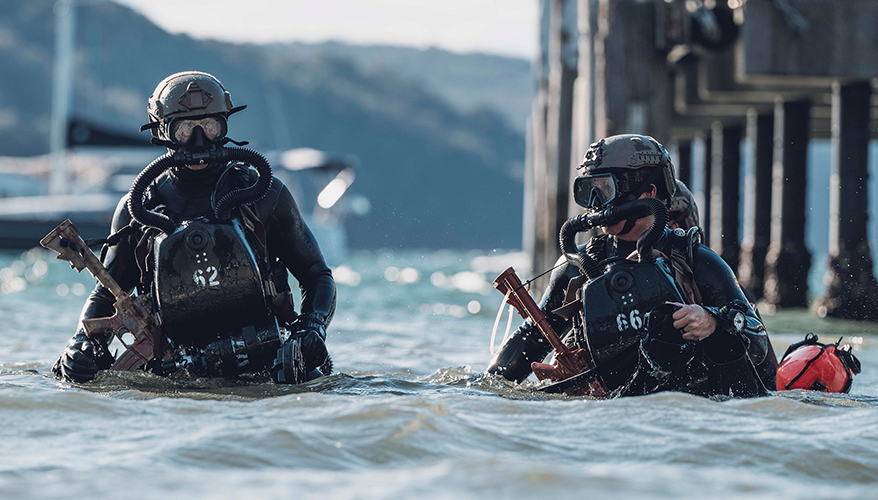
Marine Raiders participate in Exercise Talisman Sabre 25 in Sydney, Australia. (Navy photo)
The “biggest challenge” that comes with events of this scale is releasability, he said. “And that’s why that fully informed simulation environment … can't come fast enough.”
The JLVC Modernization project began laying the framework for a secure training network “before we even got policy decisions” to design a fully informed simulation environment, Rustad said.
While the capability “probably won’t be resonant across the globe” for a few years, he said, “we’re starting small and establishing a top secret training network, which will allow us to at least get after some of that exquisite capability in these bigger exercises.”
When considering modeling and simulation tools, Hill said the first thing he asks every company is: “Can you operate on that classified environment?” If the company says ‘yes,’ “I tell them to prove it, because I’ve been told ‘yes’ many times, and then it has been proven that’s not the case.”
If the answer is ‘no,’ “then you need to be able to work hard to do it,” he added. “It’s not on me to do that. I’m the demanding customer. You need to demonstrate that to us, because if you can’t, I can’t work with our allies and partners straight away. So, that’s really important.”
When participating in joint training events, different countries bring different gear, Hill explained — “our own pieces of kit that are important that we’ve made sovereign decisions around.”
The key, he said, is when they come together, “can we share that data, that instrumentation data, and then can we collate that data and put it into a constructive simulation to provide the visualization for our commanders so they can make decisions?”
Merging data is the hardest part, he said. “Because you’re then feeding it into joint data networks to stimulate [command-and-control] systems.”
When juggling multiple data standards, “asking the right questions is really important when you’re making decisions on acquisition,” always thinking back to: “Who will I use this with in the future?” Hill said.
In addition to the Joint Live Virtual Constructive Modernization effort, U.S. Indo-Pacific Command is also operating the Pacific Multi-Domain Training and Experimentation Capability, an initiative started in 2022 to link distributed live and virtual training ranges across the Indo-Pacific.
The initiative is “critically important” to the Indo-Pacific Command training mission and the region’s partners, Goodman said. Today, there are around 23 joint exercises, compared to 14 four years ago.
The need and the curve in training capabilities for partner nations is “significant,” he said. But there is positive traction and momentum building “in the areas that we most need them to be building.”
The experimentation is part of that, Goodman said. Nearly four years old, the initiative is funded by Indo-Pacific Command under the Pacific Deterrence Initiative.
“It goes into places where services and partners either won’t or can’t” to enhance and enable joint coalition interoperability across the Indo-Pacific, Goodman said.
The world is changing, he said. The adversary is changing, but so is the training audience — the units the exercises are intended to enhance.
“If our exercise mechanisms are not keeping pace” with whatever the training audience is, Goodman said, “then we are not providing that qualitative training experience for the training audience.”
To do this requires speed, cross-domain fusion and seamless integration — “a lot of things all at once,” Goodman said. A federation of systems like the JLVC will “reduce the manual operation, enhance the speed, enhance the integration that we’ve already talked about.”
“It is solutions that connect across simulations,” he continued. “This is the federation of systems, a common plug or interface based on common data standards. … And finally, it’s scalable.”
When considering speed, “as we look to catch up and run fast,” partners and allies need to consider each others’ capabilities, he noted.
“There are many partners in the Pacific who are very interested and willing and should be considered by all of you in this space as well,” Goodman said, “so that we are at pace with each other running forward.”
Hill said it is important to remember that training together means “you have to fight your threat, not yourself.”
“Some of those [threats] aren’t humans and capability,” he added. “Sometimes it’s the environment and the geography.”
While battling “tyranny of distance” and “immutable” geography is nothing new for Indo-Pacific countries, Hill emphasized that the nations’ relationships to geography can and have changed “a lot” since 1942.
As a result, “we must work much more closely with our neighbors in the region than, frankly, we have in the past,” he said. “I see modeling and simulation as an entry point into that relationship.”
Topics: International, Internation Cooperation
Comments (0)