
MARINE CORPS NEWS
Marines to Make Weapon Integration a Priority
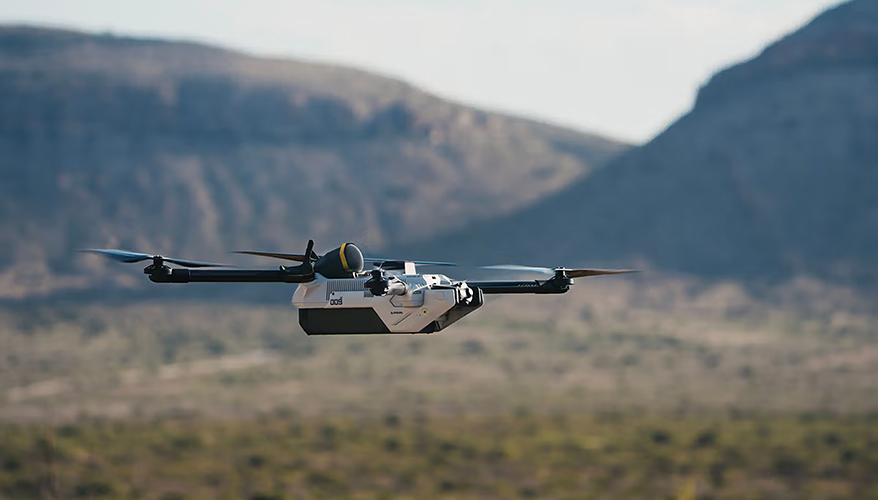 Anduril’s Bolt-M loitering munition system
Anduril photo
WASHINGTON, D.C. — The Marine Corps is working to operationalize its long-term vision known as Force Design, and its armament goals are a combination of kinetic and non-kinetic effects that the service needs to integrate seamlessly to operate in an evolving landscape.
On the kinetic front, one of the service’s top priorities is its Organic Precision Fires concept, said Col. Bradley Sams, ground weapons systems program manager, during a presentation at the recent Modern Day Marine conference.
The effort is intended to equip small, dismounted units with man-packable, precision-strike loitering munitions to destroy targets beyond line of sight without relying on external support. The Marine Corps is in varying stages of developing and fielding two versions of the concept: light and medium.
Organic Precision Fires is a “key capability” for the service and a Force Design initiative “that will provide multiple echelons of the fleet with organic, beyond-line-of-sight strike capability,” he said.
In the near term, the Marine Corps is focused specifically on Organic Precision Fires-Light, he said, announcing at the conference that he expects system fielding to operational units in the June timeframe.
The Organic Precision Fires-Light is a loitering munition system intended for small Marine Corps units operating on the front line, a service article stated. The capability will give small formations the ability to launch kamikaze drones at targets beyond the reach of rifles and other direct-fire weapons.
The service in 2024 selected AV — previously known as AeroVironment — Anduril and Teledyne FLIR for the multi-vendor effort, with Teledyne and Anduril receiving follow-on contracts following the program’s initial phase.
Teleydine FLIR in December 2025 was awarded a $42.5 million contract for 600 of its Rogue 1 loitering munitions, while Anduril in January received a $23.9 million contract to deliver more than 600 of its Bolt-M vertical-takeoff-and-landing systems.
AV’s April 2024 contract award of $8.9 million was for its Switchblade 300 Block 20 loitering munition system.
The Marine Corps announced in late April the program had successfully completed initial operational test and evaluation and early capability release, testing the full operational sequence of the OPF-Light systems, including mission planning, system deployment, target acquisitions, positive identification and simulated engagement.
During this phase, two units were able to use inert systems to figure out how they will fit into their maneuvering, Sams said. June will be the first time “we’ll get actual inerts and live warheads to the units that are on the fielding plan.”
For the OPF-Light program, the Marine Corps is looking at a variety of different technologies, because industry is changing so quickly, Sams said. Nailing down a concept of operations and “how are these things going to improve or support scheme of maneuver” are factors “we’re still looking at.”
As a result, “we are open to anything right now,” he said — whether it be fixed wing, vertical-takeoff-and-landing, launched or man-packable platforms. “Whatever it is that is available, we’re hoping to hear what is out in the industry right now as we try and get something out very quickly on this.”
The Marine Corps is also developing a larger companion system, Organic Precision Fires-Medium, aimed at battalion-sized formations.
The medium variant is a little bit bigger and expands capability to engage armored targets beyond line of sight, looking after anti-tank targets and weapons for dismounted Marine Corps anti-armor, Sams said.
According to a request for white papers released in April, the system will be transported aboard tactical vehicles and then carried by dismounted Marines. The dismounted system will “enhance target engagement capability by providing an anti-armor destruction capability beyond enemy detection and engagement.”
While the service plans to award OPF-Medium contracts in fiscal year 2028, the Marine Corps would like to move out as quickly as possible, something Sams said he hopes industry can help with.
A program wishlist Sams presented to industry in attendance included anti-armor and anti-materiel payloads, a modular design that “provides us the ability to use multiple different warheads for a variety of targets,” and that it be transportable by two Marines.
The program is also looking to reduce operator workload and potentially provide capability to control multiple munitions simultaneously. Other asks included automatic target tracking, the ability to charge and maintain charge of lithium batteries separate from the warhead and communication systems that can operate in electromagnetically contested and GPS-denied environments, he added.
The program is looking to deliver capability to the Marine Corps in phased releases, with the first phase aimed at delivering a procurement-ready baseline system within one year of contract award, the request said.
In addition to armaments programs like Organic Precision Fires, the Marine Corps is fortifying another capability essential to combat systems in the age of modern warfare: information.
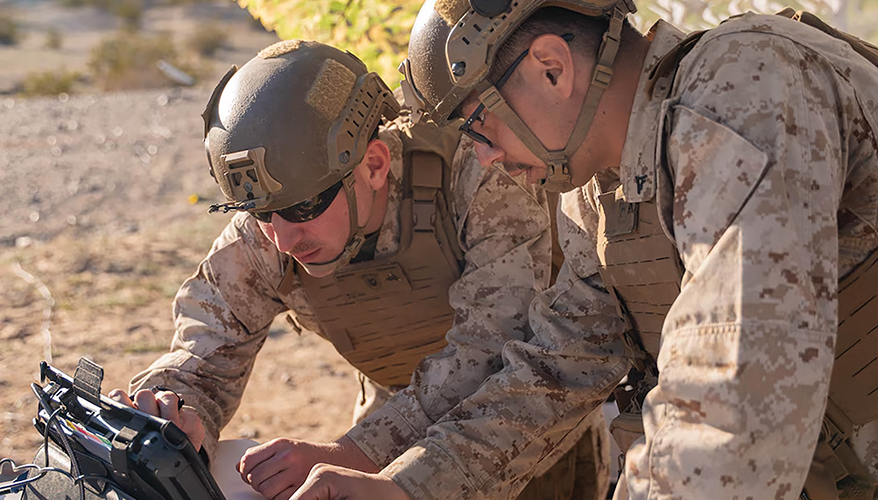
Marines conduct an early capability release test for a new loitering munition system at Camp Pendleton, California. (Marine Corps photo)
“At the end of the day, the kinetic effects are great and they’re necessary, but they are augmented … by what we bring in the information warfare domain,” said Lt. Gen. Jay Matos, the Marine Corps’ deputy commandant for information.
Marine Corps operations are all underpinned by exquisite intelligence, he said during a panel at the conference.
“You cannot do kinetic effects, you cannot do operations alone, without the accompanying non-kinetic effects elements,” he said. “I think it’s incredibly important.”
There is an “insatiable demand” and realization by combatant commanders today that non-kinetic effects are integral to what they need to do, Matos said. “They’re turning to the services, particularly to the Marine Corps, saying, ‘Hey, I need this capability.’”
Marine Corps Warfighting Publication 8-10, “Information in Marine Corps Operations,” published in 2024, includes a doctrinal process for bringing kinetic and non-kinetic effects together called the Information Tasking and Coordination Cycle.
This doctrine supports concepts like the Combined Joint All-Domain Command and Control effort that bring kinetic and non-kinetic effects to bear together, said Col. Christopher Passerella, director of the Marine Corps’ Information Maneuver Division.
“These effects can’t simply be add-ons,” he said during the panel.
Both exercises and operations have demonstrated there are times when the only actions that can affect the commander’s area of interest and the areas of influence and transition into an area of operation are these non-kinetic effects, he said. “That integration has to occur in exercises, has to occur in emerging concepts and has to occur with experimental units.”
The Marine Corps is “absolutely working on that” and has laid a doctrinal framework to move forward, he added.
One important bridge between kinetic and non-kinetic effects is sensors.
“From an intel perspective, first and foremost in my mind is sensing capability — sensing and sensemaking,” said Maj. Gen. Mark Cunningham, the Marine Corps’ director of intelligence. “That includes long-range sensing, multi-domain, and that’s really where our focus needs to be.”
From an acquisition perspective, purchasing sensors that are going to last 10, 20 or 30 years is probably not the answer, he said during the panel. Sensors are flowing in and out of the theater at a rapid rate, and “we need to be able to figure out a way to change out sensors based on new technologies and new capabilities, to change the software in these systems.”
Cunningham said he is really concerned about this, and long-range, multi-domain sensors are needed at the edge for men and women in harm’s way. “It’s imperative that we get after that.”
Sams listed sensors among several of his ground weapons systems priorities, including navigation tracking of jumpers and cargo parachute systems; tactical ranging devices; and compact, marinized, electro-optical and radar sensors for vehicles, boats and munitions.
When thinking about targeting, Cunningham noted that five of the military’s six kill chain elements — find, fix, track, target, engage and assess — involve intelligence and sensing.
“If we’re going to do this dynamic targeting at speed and scale, we need to make sure that we have the sensing capabilities and sensemaking capabilities to be successful in today’s fight and in the future,” he said.
No information warfare conversation is complete without a sprinkling of artificial intelligence — an idea that Jeff Hurley, the Marine Corps’ director of command, control, communications and computers, cautioned against.
“Sprinkling AI on something does not necessarily make it the solution,” he said during the panel. “Proper utilization of AI in a way that enables the Marine Corps actually solves that problem.”
Matos said artificial intelligence has its place as an operational support capability. “How do we get missiles downrange faster, more accurately? How do we get more planes in the air?”
When it comes to training with AI, does every Marine need to be a data scientist? “I don’t think so,” Matos said. “But how many do we need, and what does that look like?”
Every Marine should be familiar with AI and how to utilize it at a basic level, he said. “I think there’s a lot to learn” on best practices from other services, academia and industry.
In the old days, cyber belonged to the information technology folks, hidden in air-conditioned back rooms with the ability to turn off a network at will, Hurley said. The reality today is different.
“Every Marine out there is an IT specialist of some sort. They have to understand AI. They have to understand exactly how their networks work, what to report, when to report it,” he said. “Until we get to that point, we are going to be challenged moving forward.”
Topics: Armaments, Integrated Precision Warfare
Comments (0)