
TRAINING AND SIMULATION
NATO Wants More AI to Streamline Training, Simulation
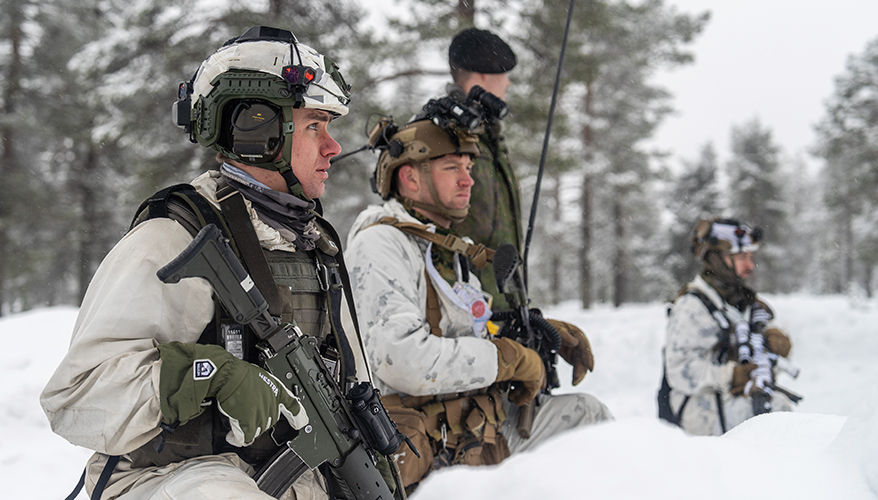 U.S. Marines and Swedish troops train together in the recent Exercise Cold Response in Finland.
NATO photo
LONDON — NATO has used artificial intelligence to help organize one of its major exercises for the first time, but on a small scale. The alliance’s leadership is now asking organizers to expand its use, a senior official recently said.
German Army Maj. Gen. Ruprecht von Butler, commander of the NATO Joint Warfare Center, said the war between Russia and Ukraine has transformed the alliance, and the way training is perceived is part of its evolution.
“All these NATO commanders, they are extremely interested to be ready to fight tonight,” he said at the ITEC training and simulation conference in London. “Exercises now have significantly changed.”
In the past, large-scale real-world training and wargaming for strategic deterrence were separate. Senior leaders are asking to bring all that together, he said.
The high-level wargaming was carried out every three years, and by the time the next iteration came around, the leaders who took part had moved on. Setting up these exercises also took upwards of 500 personnel, he added. That’s no longer acceptable.
AI was used to help organize the Steadfast Deterrence command post exercise scheduled to start on May 1, but its employment is still in its infancy, he said.
“This is enormous, but it’s still at a baby stage. I would say there [are many] more possibilities,” he said.
One of its main benefits will be sharply reducing the number of people required to come up with the scenarios and assessments. An exercise such as Steadfast Deterrence, for example, would take 200 to 250 personnel to do the post-exercise assessment.
The 2025 version took place over nine days at the Joint Warfighting Center, Supreme Headquarters Allied Powers Europe and U.S. European Command and involved 4,800 military and civilian personnel. It incorporated simulations for cyberspace and space, “the cognitive dimension” and strategic communications, according to a NATO press release.
Von Butler said war is still an “art” and not entirely science, and doing assessments after major exercises still requires human judgment. But with the help of AI, that 250 number could be reduced to 20 or 30 people, he added.
“This will make you extremely faster — and that’s what I’ve seen — especially on the system we are using now,” he said.
Setting up the exercise is also manpower intensive as it involves the defense plans and capabilities of all the member nations, simulating their 3 million troops and 18 command structures, he said. Plus, it must ingest Russian capabilities to come up with a script.
“I’ve been clearly tasked by my higher headquarters to significantly reduce these [personnel] numbers and then to have these exercise preparations more AI-based, and also more based on experiences we have had in [previous] exercises,” he said. “What are the weaknesses of our alliance? What weaknesses [should we] really focus on and deliver an exercise against them?”
On a side note, von Butler said one part of training has changed. The alliance has done away with the niceties of using terms such as “Country A” or “Country B” in its wargaming. Today, they just say, “Russia.” It’s ultimately about deterring the nation from attacking a NATO member, and the exercises are based on real war plans, he said.
Von Butler welcomed industry to help the Joint Warfare Center incorporate more AI into its exercises. It wants to look at some of its shortcomings from the Steadfast Deterrence exercise and learn where it still needs assistance.
“But you have to [have] a system which is operational at a NATO Secret level. If this is not NATO Secret, forget it,” he said.
“Finally, it must make us faster with less people. If you offer me something and say, ‘This is fantastic,’ but you require another 100 or 200 people to deliver it, forget it. I have no interest. I’m not going to procure this, not at all,” he said.
Topics: International, Emerging Technologies
Comments (0)