
ARMY NEWS
COMMENTARY: Army Test and Evaluation Command Empowering Industry Partners
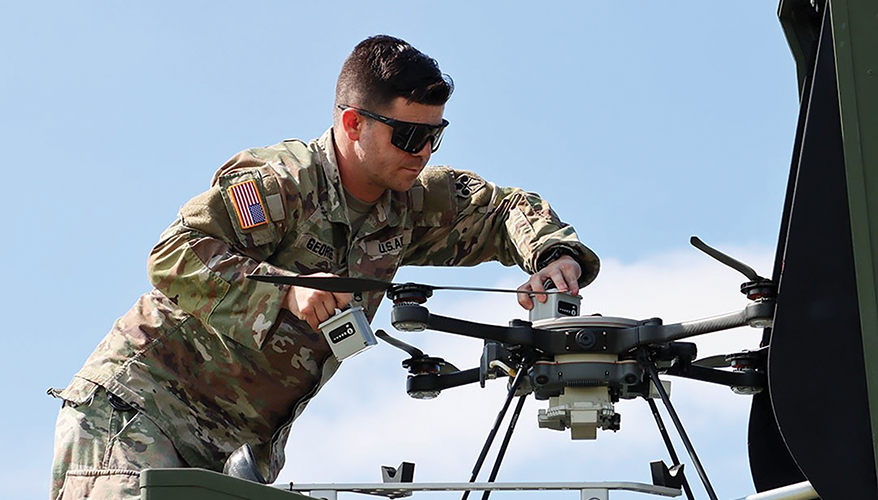 A soldier from the Army Chemical, Biological, Radiological, Nuclear School sets up a drone at Aberdeen Proving Ground, Maryland.
Army photo
The Army is in the middle of a rapid, continuous transformation to maintain its competitive edge against evolving threats.
This new landscape demands agility and deep collaboration with industry partners to integrate cutting-edge commercial technologies at the speed of relevance. At Test and Evaluation Command, we are committed to evolving in lockstep with the Army, and that means transforming processes to bring solutions to the field faster and more effectively.
A key tenet of our strategy is to empower the Army’s industry partners to rapidly mature their systems. This includes providing unprecedented access to world-class, one-of-a-kind test ranges for their own internal research and development, prototyping and rapid experimentation.
One of the ranges is the Aberdeen Test Center in Maryland. It is the Army’s premier hub for direct-fire, survivability, automotive and vulnerability testing. It acts as an unmatched outdoor laboratory for comprehensive evaluations of combat vehicle performance, weapon systems and soldier protection systems.
Another is Dugway Proving Ground in Utah. Spanning nearly 800,000 acres, it is the nation’s primary facility for testing chemical, biological, radiological and explosive defense systems. Beyond those categories, its massive physical range footprint and restricted airspace make Dugway an ideal location for rapid, affordable industry testing of unmanned aircraft systems, counter-UAS and launched effects.
And there is the Electronic Proving Ground in Arizona. It executes premier developmental testing for command-and-control systems and sensors, electronic warfare, GPS and assured positioning, navigation and timing systems. It offers a unique, electromagnetically quiet environment critical for evaluating secure communications and signal dominance.
Redstone Test Center in Alabama provides state-of-the-art facilities optimized for testing aviation, missile and sensor systems. Its core strengths include line-of-sight missiles and rockets, advanced guidance systems, shoulder-fired weapons and aircraft platforms.
Meanwhile, White Sands Missile Range in New Mexico delivers premier, large-scale research, development and training facilities. It specializes in air and missile defense systems, directed energy weapons, nuclear weapons effects simulation and non-line-of-sight missile testing.
And then there is Yuma Proving Ground in Arizona. It is the Army’s premier center for extreme natural environment testing. It extends to the Arctic Regions Test Center in Fort Greely, Alaska, and the Tropic Regions Test Center in Panama. These facilities specialize in testing indirect fire artillery, air delivery systems, rotary-wing aircraft armaments, unmanned aircraft systems, counter-UAS and launched effects, and counter-improvised explosive devices.
Industry has always had the opportunity to use these one-of-a-kind test environments, but that access has not always been straightforward or prioritized.
That has changed. The command has revamped its internal processes to create a “fast lane” for industry, streamlining access and ensuring that partners are a primary focus.
By giving vendors the range space they need to mature their novel solutions, we are accelerating the prototyping and maturation of new technologies. This allows for faster, cheaper and more frequent iteration, reducing delays that can stifle innovation and offering the opportunity for the command’s experts to contribute to early system evaluation if the partner desires.
The benefits extend far beyond industry partners. For the Army’s portfolio acquisition executives and capability program executives, this initiative de-risks the entire acquisition enterprise. When vendors are ready to present their technologies, those technologies are more viable, more mature and have been proven in realistic operational conditions. This accelerates individual programs and enhances the Army’s portfolio-level strategy by expanding the pool of mature, range-tested solutions ready for potential procurement.
The command is also solving critical capacity challenges. By optimizing the use of test centers and matching industry needs to available capacity, we are removing logistical and financial burdens from partners and preventing bottlenecks that can delay capability delivery to our soldiers.
In addition to enhanced range access, the command is actively seeking innovative ideas from industry through the Army Open Solicitation, which provides a permanent, open doorway for companies to propose commercial products, advanced prototypes and research that can close critical capability gaps for the service.
Beyond informal collaboration, the command offers opportunities for formal partnerships, such as cooperative research-and-development agreements with industry and academia. These agreements allow for shared-cost research and development, leveraging both government and private sector resources to accelerate the development of new technologies. These and other partnership agreements provide a structured framework for long-term collaboration, ensuring that we are building enduring relationships with our industry partners.
By streamlining access to test ranges, actively soliciting new ideas and providing opportunities for formal partnerships, the command is not just empowering industry — it’s accelerating the entire Army transformation enterprise.
For more information on partnering and testing with ATEC, visit atec.army.mil/partner.
Topics: Warfare, Defense Innovation
Comments (0)