GLOBAL DEFENSE MARKET
Despite Sovereignty Push, Europe Still Open to U.S. Defense Firms
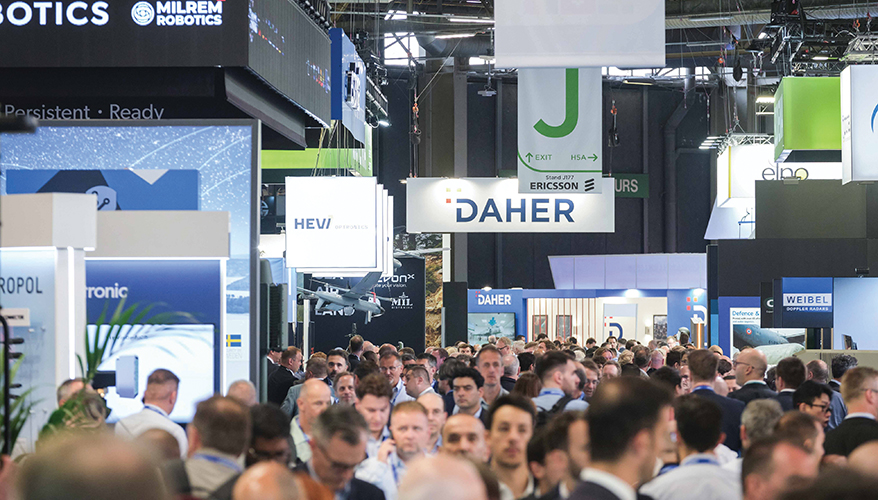 Eurosatory defense exhibition
Eurosatory photo
PARIS — Europe is increasing its defense spending to boost its industrial base, investing in more sovereign capabilities to reduce reliance on other countries, particularly the United States.
Despite the shift, opportunities for U.S.-based defense contractors are still available, primarily in manufacturing and production capabilities, experts and industry officials said.
Pursuing sovereign capabilities to develop strategic autonomy has become a priority for Europe as a whole, especially in the midst of the ongoing conflict in Ukraine.
Capt. Béatrice Hainaut, research fellow at France’s Institute for Strategic Research at the Military School, said strategic autonomy is “the idea to ensure that Europe has the capacity to act in a true, meaningful way whenever it chooses to do so, and it also means to have the ability to act when necessary, but not the ability to act alone, of course.”
While the concept of strategic autonomy is not new, the war in Ukraine has served as a wake-up call that has exposed Europe’s financial limitations and capability gaps, she said during a panel discussion at the Eurosatory defense exhibition.
Jerry McGinn, director of the Center for Strategic and International Studies’ Center for the Industrial Base, said there is tension in European governments, similar to the current climate in the United States.
“When they increase spending, they want to spend it in their borders. It’s ‘buy America,’ or it’s ‘buy Sweden,’” he said in an interview. “That’s a natural inclination for every politician.”
In the United States, the export of defense-related articles and services is controlled by the International Traffic in Arms Regulations, or ITAR, which can be a hindrance to foreign customers, said Oscar Angel, product manager for Teledyne FLIR.
The regulations can make sales to foreign customers more complicated and difficult, and Europe is searching for solutions that are ITAR-free, Angel said in an interview on the sidelines of the trade show.
To spur the development of sovereign capabilities, the Council of the European Union adopted the Security Action for Europe, or SAFE, in May 2025, a new financial instrument designed to provide loans to member states to “speed up defense readiness by allowing urgent and major investments in support of the European defense industry,” the European Commission website stated.
SAFE stipulates that components produced outside the European Union and Ukraine can constitute no more than 35 percent of the total cost of the end product. While it allows for countries that have security and defense partnerships with the EU to negotiate enhanced terms, the complex rules around non-European participation could reduce procurement options and strain relations with allies, according to a December 2025 research paper from the International Institute for Strategic Studies.
The 35 percent limit restricts third-country involvement primarily to supply chain participation, because few products developed by third-country prime contractors have more than 65 percent of their components produced in the EU, the paper said.
This largely reflects the reality that defense product development is typically funded by the prime contractor’s home government, which naturally prefers to see a large proportion of the subcontractor value flow down into the domestic supply chain rather than going abroad, it noted.
As a result, for most products coming from outside of Europe, final assembly and a substantial portion of the supply chain would need to be in the EU to comply with the 35 percent content limit.
The paper’s authors interviewed non-European companies and found that some were willing to shift supply chain value to the EU, but that others found it impractical.
For example, onboarding new suppliers is generally a lengthy and complex process and carries a significant cost, the paper said — particularly for more complex products and those that require certification, such as air and naval systems.
How these stipulations will impact the European defense market for U.S. companies is the big question, McGinn said. And the answer is not clear yet.
“The question with the SAFE Act is — does it eliminate the possibility for U.S. companies to do business in some of these markets, or does it make it harder? What kind of impact does it have?” McGinn said.
The International Institute for Strategic Studies paper noted that SAFE language makes clear that it was set up to support member states in making major public investments that support the European defense industry, as opposed to third-country companies — a fact that could hamper non-EU involvement.
The paper analyzed a collection of rules within SAFE articles that explicitly refer to and could hinder third-party participation, from EU design rights to conditions that stipulate a third-country subcontractor must already have been part of a product’s contracted supply chain when SAFE was implemented in order to receive funds.
However, SAFE also acknowledges that most EU defense products contain at least some third-country components, and these partnerships are important given the urgent need to rebuild the inventories of Europe’s armed forces, the paper noted.
For U.S. defense primes, SAFE may not have a significant impact on opportunities to sell in Europe.
Juan Hernandez, vice president of international business development at U.S.-based vehicle maker AM General, said working with international restrictions and regulations is “doable.”
“We’ve got legal counsel. We’ve got lawyers and a team that helps us get through all the export licenses. It’s never been an issue,” he said in an interview at the tradeshow.
The company already has an established international market, and it hasn’t slowed down, Hernandez said.
“We’ve got a huge, huge presence already. We have an extensive network of representatives and distributors around the world — to include Europe,” with lots of opportunities, especially in the tactical wheeled vehicles market, he said.
Navigating the implications of SAFE is something many U.S. companies, including AM General, are figuring out as they go. Hernandez said the restrictions are an opportunity to do things differently.
“I always see it as an opportunity, and I think most businesspeople will do that. They will say, ‘OK, here’s an opportunity for us to get into something.’ And we’re changing the way we do business to adjust to that, which is good,” he said. “You [have] to think of creative ways of getting that business.”
But for firms without big budgets and teams of lawyers, SAFE is likely to present more obstacles, McGinn said.
Ultimately, only time will tell what effect SAFE will have on U.S. companies and whether or not it will squeeze them out or simply give European industry a leg up, making the market a little more competitive, McGinn said.
SAFE could have a positive impact on the European defense market if it helps make companies more willing to invest in capital expenditure, he said. “That’s a good thing.”
In spite of Europe’s focus on sovereign technology and the impacts of SAFE, the growth of defense budgets abroad still creates new opportunities for U.S. companies, McGinn said.
“The fact of the matter is that there isn’t enough capacity in Germany to build everything for Germans, right? And the markets are smaller, so you can’t really have companies that only serve domestic markets — other than the U.S.,” he said.
Right now, the European defense market demands more investment, creating a huge opportunity for U.S. manufacturers, mainly due to the United States’ already-established manufacturing ecosystem, said Assaf Chaprak, co-founder and chief technology officer of Washington, D.C.-based autonomous robot company Shifters.
“A lot of manufacturing … has gone out of the West, and it’s now more difficult to claim it back and scale back up,” he said in an interview. The reindustrialization movement in the United States has been growing rapidly and has produced manufacturing capacity that European markets are unable to match quickly.
“They are scaling up, but U.S. manufacturers have an advantage of an established manufacturing base that is also growing very rapidly, and that is where I see the opportunity,” he said.
McGinn said another big opportunity he sees for U.S. companies is in co-production.
For example, the U.S. State Department in May granted Poland preliminary approval to produce Lockheed Martin-designed Patriot Advanced Capability-3 Missile Segment Enhancement interceptors, according to Polish press reports. More opportunities for U.S. companies to co-produce certain capabilities in other countries are likely to pop up as European nations look to identify and fill gaps.
If both the United States and European countries want to build more High Mobility Artillery Rocket Systems in Germany or more Long Range Anti-Ship Missiles in Finland, then the U.S. primes can make licensed production deals with those countries, McGinn said.
“I think there will be those kinds of opportunities, and we’ll see how those develop or not,” he said.
Despite Europe’s focus on achieving industrial autonomy, there are still opportunities for defense contractors based in the United States in the European ecosystem. But as SAFE continues to develop and prioritize European-made products and capabilities, it’s up to the U.S. companies to make an impact on the market they want to sell into, McGinn said.
“That means creating jobs, setting up subsidiaries, negotiating work-share agreements with other subcontractors in that country,” he said. “It’s incumbent on the U.S. companies looking to do business to work in favorable manners to that marketplace, so they can develop business, but it also benefits the country, their target market.”
Topics: International, Industrial Base
Comments (0)