
SHIPBUILDING
JUST IN: Maritime Workforce Education Isn’t Working, Report Finds
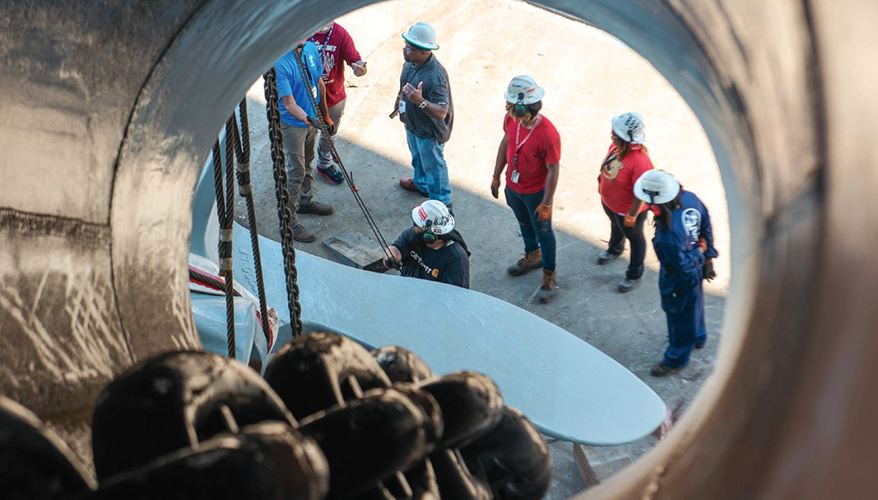
Navy photo
A new report examining gaps in the U.S. maritime talent pipeline suggests that its “critical” shortfalls will require an educational overhaul to address the gap at its source.
The report, published by McKinsey & Company on Jan. 12, echoed a familiar warning: defense shipbuilding in the United States is “significantly behind” in producing the volume of ships and submarines the Defense Department requires.
According to the U.S. Department of Labor, an estimated 200,000 to 250,000 additional maritime workers will be required to satisfy demand over the next decade, and the labor gap could widen further still if the demand for ships increases.
The maritime ecosystem faces "critical talent gaps,” the report found. The U.S. government has acknowledged these gaps and is “committed to strengthening the maritime labor force” — in part by examining its education, including programs focused on nautical education and the creation of new maritime academies.
While such efforts will likely improve the talent pool, the talent gap requires “more transformative strategies” to build a maritime workforce prepared for the future, the report said.
This will include a reassessment of how the maritime education pipeline operates. Among the report’s recommendations for shipbuilding stakeholders were bolstering the pipeline of talent from educational institutions to shipyards and encouraging better skill building through educational partnerships.
The United States does not just have a talent gap, it has a maritime education pipeline gap, the report said. Maritime organizations and educational institutions across the United States have long provided future nautical workers — including engineers, naval architects and shipyard managers required to plan, supervise and perform complex shipbuilding work, it noted.
Public schools that offer maritime education without military service exist, including the U.S. Merchant Marine Academy, several four-year colleges that offer naval architecture and maritime engineering programs and some two-year schools and private organizations with programs “suitable” for shipyard employees, the report said.
However, despite its distinguished history, maritime education now faces several “pressing challenges,” including long-term declines in enrollment. At its current level, the scale of four-year maritime education is “insufficient to provide the talent needed for large projects” such as destroyers, carriers and submarines, which require thousands of new hires each year.
Training programs for skilled trades are also producing an insufficient number of workers, in part due to high attrition rates, the report said.
Similarly, two-year community colleges receive a high number of applicants, but nearly half drop out within a year, according to data from the National Student Clearinghouse Research Center.
In addition to the numbers problem, some institutions and programs also have a skills problem — they are not building the most critical skills, the report found. Frontline trade workers often need significant retraining because their courses or programs did not emphasize the actual skills and technology used in shipyards.
Part of this problem comes from old vessels used to train, often without modern equipment or digitized systems — things educational institutions may not be able to afford. In other cases, curriculums simply aren’t updated often enough to reflect advances in technology.
As shipyards move towards digital shipbuilding and new technologies, such as computer-aided design and manufacturing, robotics and additive manufacturing, training and apprenticeship programs need to focus on them to better prepare talent.
Shipyards should also form partnerships with educational institutions or groups that are willing to offer relevant coursework, the report added.
In addition to updating current educational programs, “novel approaches to finding new labor are necessary,” the report said — which should include the creation of new programs, such as service and conservation corps programs designed to place college students into formal careers.
The report also recommended creative recruitment — shipyards and industry organizations should “think about who they recruit, not just how they recruit” by drawing talent from nontraditional sources, such as training programs aimed at women or campaigns targeted at groups of untapped talent.
But before any programs or institutions can impact the talent gap, students need incentive to join them in the first place.
The report emphasized providing a strong return on investment to students who invest in maritime training and education. “For students, the ROI equation is simple,” the report said. “They must weigh tuition and fees and the potential opportunity costs of being in school versus the benefits of a potential maritime career.”
This equation illustrates the importance of showing prospective students that maritime jobs are “worth it,” the report said.
Educational institutions and industry organizations need to create financial benefits and reduce the financial burden on students, such as investigating cost-reduction strategies that shift return on investment in favor of training, and create connections to employers that show students their careers will succeed.
Topics: Maritime Security