
DEFENSE CONTRACTING
Defense Sector Inflation Threatens to Eat Away at Budget Plus-Ups
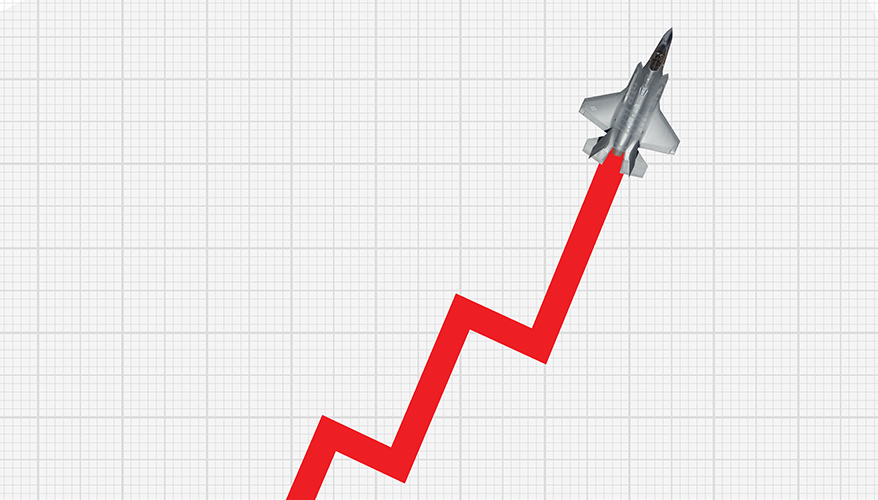
iStock illustration, Defense Dept. photo
In December, the Swiss government announced that it was reducing its planned buy of 36 F-35A Joint Strike Fighters from U.S. manufacturer Lockheed Martin.
“Due to foreseeable additional costs, it is not possible from a financial policy perspective to maintain the originally planned number,” officials said in a statement.
Rising energy and material costs, in particular, were said to be forcing the government — under a spending cap for the program — to reduce the buy.
On the other side of Europe, the 155mm shells that Ukrainian armed forces were firing at Russian forces now cost approximately $8,000 each.
Before the outset of the war, those same rounds were about $2,000.
These are just two bellwethers for what some analysts and industry sources say are potential inflationary pressures in defense spending that will far outpace what consumers are paying for milk and eggs.
One inevitable contributor is the massive influx of funding from the United States to Europe to Asia, where governments are pledging to spend 3.5 percent of GDP or more on defense. Another is the Trump administration’s proposal of a $500 billion increase for the Defense Department in the next budget cycle.
That massive amount of money will require factory capacity, which is lacking — especially in Europe.
The big boosts in defense spending will also require more raw materials and skilled labor. Shortfalls in both create what is taught in every Economics 101 class — a supply-versus-demand mismatch that forces prices to go up.
And rising prices, in turn, eat into how many platforms militaries can acquire.
All this was brought to the fore by a United Kingdom-based banker in a panel discussion on financing at the DSEI UK conference in London last year.
“When you have an influx of cash coming into any sector and companies in the supply chain are unable to expand their operations, it creates inflation,” said the expert, whose name and affiliation could not be revealed because he was speaking under the Chatham House Rule.
The 3.5 percent GDP goal will amount to an extra $1.3 trillion obligated to the defense sector in Europe alone each year, he noted.
“We are already seeing this,” he added, noting the 155mm shell example and adding that tanks sold to the Dutch military for $23 million each in October 2024 cost $7 million more when sold to Austria in January 2025.
“Defense inflation is already here, so all the uplift in defense spending — unless we’re able to redesign our financial architecture, get credit down into the supply chain … all this extra money is simply going to be” absorbed by inflation, he said.
Netherlands Air Force Gen. Onno Eichelsheim, the country’s chief of defense, said in an interview that inflation was a cause for concern.
“You see the prices go up and the production being less, and the timelines when we get the materiel are getting longer. So, that’s what I’m worried about,” he said.
Yet industry leaders come to him with hat in hand asking for more orders. Then, he said, he’s told that what he’s asking for can’t be delivered until 2038, for example.
“I’m not blaming industry. I see that we have to come up with another solution to make sure that we don’t have high inflation,” he said.
Dan Darling, vice president of market insights at Forecast International, said in an interview, “Defense inflation is always higher than regular inflation.”
It begins with the fact that the defense sector is a monopsony — reliant on only one customer, he said. Then there is the chronic shortage of skilled technical workers — a problem that is much talked about, but doesn’t seem to be getting solved.
“Quality technical workers is paramount, and they’re short-handed, and so that’s your first point of inflation. You have to pay more for a skill set than on average that you would pay versus another commercial, industrial player,” he said.
Complexity in modern weapon systems in another factor. It almost all runs on expensive software of some kind.
“Think about buying a new car, as opposed to 10 years ago. Much [of] the cost of a car has gone up. It’s all the computers and widgets they add in. You have basically 12 computers on a new car,” Darling said. That’s naturally going to raise the unit price of a standard vehicle.
“It’s the same exact thing with advanced military equipment. They’re building a better widget,” he said. “Look at an F-35: other than the munitions on it, it’s basically a flying computer,” he added.
“Defense inflation is very real. You have to spend more to keep up with that inflation, and this is why countries like South Korea, Turkey, India — and to a degree, Australia — are pursuing more and more localized production,” Darling said. Exchange rates might be undervalued compared to the dollar, so it’s best to keep production in country, he said.
Mark Cancian, senior advisor at the defense and security department at the Center for Strategic and International Studies, said in an email that he was also observing inflation in the weapons and munitions supply chain.
“Some comes from a need for skilled personnel, which drives up wages and recruiting/training costs,” Cancian said. “Some comes from competition for a limited global supply for certain scarce resources, such as energetics. This will sort itself out as companies expand their production facilities, but that will take time.”
However, he cautioned against reading too much into the rising cost of 155mm rounds, noting that there are several expensive “smart” and lower-tech versions of the munition. He calculates that they were $800 a round early in the conflict, and $1,440 more recently. There are high-tech versions that can go as much as $10,000 per round, he said.
While sector-by-sector statistics on inflation are hard to come by, and the evidence is mostly anecdotal, one industry analyst said it’s just Economics 101.
“The definition of inflation is too much money chasing too few goods, right?” said the analyst, who declined to be named. “If we get another massive budget increase in the U.S., and Europeans are going to sustain higher spending — and the Japanese and the Koreans and the Australians and the Philippines are all spending more — is that going to be too much money, chasing too few goods? Is the capacity going to keep up?”
Inflation in the defense industry was pronounced during the COVID-19 pandemic, but the analyst said he is seeing it continue to rise.
“I’ve been seeing the impact from inflation, and it will continue,” he said. The problem is probably the most acute in the U.S. shipbuilding industry, which recently received a green light from the government to raise wages to tackle chronic worker shortages, he noted.
Cancian said recent indications that the Trump administration wants a massive defense budget boost, along with an executive order insisting that companies boost capacity, may end up in further inflationary pressures.
“Increasing the size of the defense budget is critical to achieving the goals of the National Security Strategy. However, adding capacity takes years, and adding orders without capacity creates inflation. Both the Biden and Trump administrations have moved to increase capacity — some of which is now coming online. However, shipbuilding is a laggard, and it will be many years before shipyard output increases significantly,” Cancian said.
The market analyst said labor appears to have the upper hand in the U.S. defense sector, noting the Boeing and Pratt & Whitney labor strikes in 2025 that ended with their skilled workers receiving raises, thus adding to the price of military platforms.
“It seems like labor has had a fair amount, or probably more power, in that relationship than they’ve had for a while,” he said.
Inflation is apparently a topic that defense contractors are reluctant to discuss. National Defense reached out to the seven U.S.-based defense contractors — including the six largest. Five of them did not respond to a request for comment at all.
A Lockheed Martin spokesperson did respond, but said the company couldn’t comment at this time on inflation.
On Switzerland’s decision to reduce its planned F-35 buy from Lockheed, the company did provide a statement, but it did not shed any light on the situation.
However, in a Form 10-Q document submitted to the U.S. Securities and Exchange Commission at the end of the third quarter in 2024, the defense giant stated: “Elevated levels of inflation and macroeconomic conditions present risks for [Lockheed Martin,] our suppliers and the stability of the broader defense industrial base. Certain costs, including rising labor rates and supplier costs, have increased as a result of inflation, and have adversely affected our margins on certain programs.”
Defense company RTX, in its SEC filing for the same quarter, stated that single-source suppliers of some raw materials and microelectronics resulted in delays and increased costs.
“High inflation levels have increased material and component prices, labor rates and supplier costs, and have negatively impacted our operating profit and margin,” it said.
The analyst said for cost-plus contracts, the government ends up on the losing end of the equation as it must absorb costs associated with inflation, which reduces its buying power.
“I guess if the budget goes up enough, maybe it doesn’t matter, because [a military] can get the same or more stuff, and you have the dollars to do it. If you’re in a very constrained budget environment, that would be a problem,” he said.
But for fixed-price contracts signed years ago — which can be as much as 60 percent of today’s deals — the companies “have to eat that,” he said.
Meanwhile, if defense inflation isn’t kept in check, Forecast International’s Darling pointed to Norm Augustine’s well-known tongue-in-cheek prediction.
The former Army secretary and defense executive said, “In the year 2054, the entire defense budget will purchase just one tactical aircraft.
This aircraft will have to be shared by the Air Force and Navy three-and-a-half days each per week, except for leap year, when it will be made available to the Marines for the extra day.” ND
Topics: Defense Department