
TRAINING AND SIMULATION
JUST IN: Army Rebrands its Training, Simulation Acquisition Office
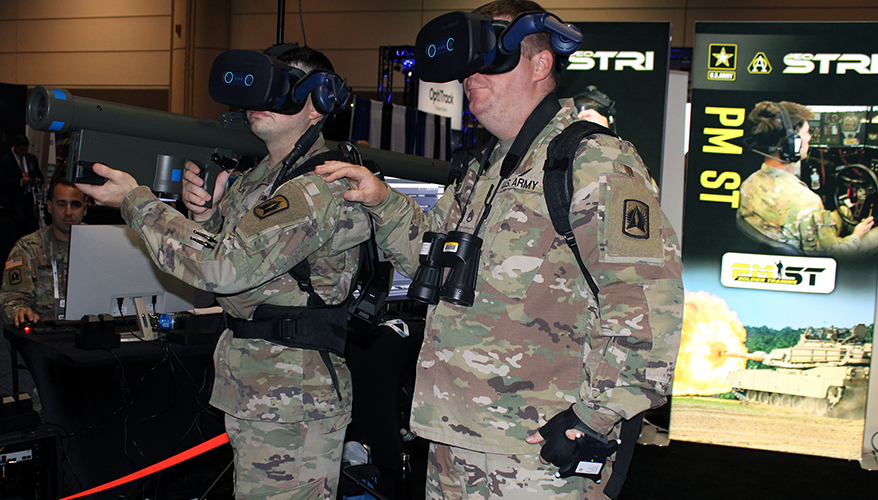
Army photo
LONDON — The Army organization formerly known as the Program Executive Office Simulation, Training and Instrumentation is now the Capability Program Executive Simulation, Training, Test and Threat.
Brig. Gen. Christine Beeler, formerly the office’s PEO, is now its capability program executive.
Beeler spoke about the changes from what was widely known as PEO-STRI to its new acronym CPE ST3, and the thinking behind the name change at the ITEC conference in London on April 15.
“If we think about the total package of what ST3 does: simulation, training, test and the threat domains are all the products that we deliver for the Army — and in many cases, for the Joint Force,” she said.
While the word “instrumentation” is no longer in the office’s title, that is still part of its portfolio, she said.
“The test domain includes instrumentation. But as we are converging training and test together, we're finding it's the same — there's the same tools. I need the same tools to instrument a range as much as I need those same tools to instrument a National Training Center and in our test environment. We're no longer testing things on the range. We're doing actual in the middle of exercises, testing capability in a fight,” she said.
As for the new title of capability program executive, that change is part of the larger Pentagon acquisition reform push. In November, Secretary of War Pete Hegseth introduced sweeping reforms on how the Defense Department conducts its business, which included the “portfolio acquisition executives” concept.
The Army consolidated its main acquisition offices into six organizations — Fires; Maneuver Ground; Maneuver Air; Agile Sustainment and Ammo; Layered Protection and Chemical, Biological, Radiological and Nuclear Defense; and Command and Control and Counter Command and Control.
CPE ST3 now falls under Command and Control and Counter Command and Control, which Beeler said was a natural fit.
The six offices are intended to align closely to the warfighting functions, she added.
“If you think about the tech stack, how do you get at intel? How do you get at command and control? The training environment is absolutely interconnected in that space. And so while we cross all of the warfighting domains to deliver training capability and products, the C2, counter-C2 guys do as well. So, there's a nexus there, and we're using the same tech stack and the same ideas,” she said.
The ultimate goal is to field technologies at greater speed, she said.
“Obviously cost matters, obviously performance matters. But how do I get that capability to the hands [of soldiers] faster?” Beeler said.
Topics: Global Defense Market