
LOGISTICS AND MAINTENANCE
JUST IN: Pentagon Using AI to Address Weapon System Readiness Challenges
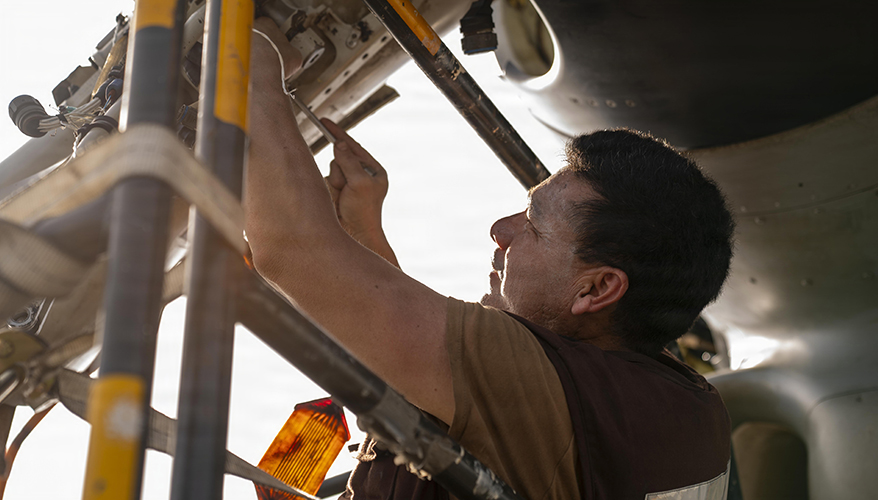 A sailor performs maintenance on an MV-22 Osprey in May.
Navy photo
The Defense Department is facing major challenges sustaining its weapons systems, and it has turned to artificial intelligence to improve the readiness of key capabilities.
Across its ground combat vehicles, naval ships and aircraft, the Pentagon is dealing with significant maintenance delays, parts shortages and a lack of trained personnel to perform repairs, according to Diana Maurer, director of defense capabilities and management at the Government Accountability Office.
As a result, the mission-capable rates of these systems have declined, with the services struggling to get platforms ready for action when called upon to perform their missions, Maurer said during a panel hosted by the Acquisition Innovation Research Center on May 26.
Patrick Kelleher, deputy assistant secretary of war for materiel readiness, said one of the causes of the department’s “sustainment debt” has been a “disaggregated approach” to readiness. The individual services would try to solve their own challenges, when “in fact those readiness challenges are much more cross-cutting and require a much more integrated solution than one service could bring into realization by itself,” he said during the panel.
The department has initiated a “readiness campaign plan” that will “holistically integrate the things that are going on across the department” and create alignment across the services, the Defense Logistics Agency and the Pentagon on how to overcome the sustainment challenge, he said.
To assist with this campaign, the department has developed an AI-enabled readiness assessment tool called Monument, he said. The system categorizes weapons systems and “allows us to be very quantitative about what is degrading readiness … so we can be very clear and specific when we identify requirements that we must invest in these five widgets to improve readiness of these end items by x percent in this amount of time.”
The Pentagon has generally struggled to articulate “how much readiness your next marginal dollar will buy,” Kelleher said, and as a result, sustainment has not competed well against other requirements during the budgeting process.
“It’s been more nebulous in how we have articulated” the readiness issues, “and so that's one of the things that I'm trying to change,” he said.
Monument is helping stakeholders within the department “come to a mutually agreeable, quantitative solution, so that we collectively can put that bill on the table, so that we can be more effective in articulating the requirement of resources and doing what we need to do to drive readiness,” he said.
Along with the Monument system that is identifying what parts are needed, the Pentagon is developing a separate AI tool to find suppliers for those parts, he added.
“We are using AI to develop optionality across the department, and … we take that back to the services or the weapon system program managers, now we have a conversation about the things that we're doing,” he said.
While AI is helping solve the Pentagon’s parts problem, the department is still struggling to find the people to put those parts on its weapons systems, Kelleher said.
“We have personnel deficiencies in the organic industrial base” that are and will continue to impact readiness, he said. “We simply do not have a sufficient workforce to execute the work that was planned to be conducted, and so we're going to fall behind, we're falling behind, and we're going to continue, because there's no short-term fix.”
The department could go on a hiring spree, but all those new maintainers would need to be trained, and “it's very difficult to replace the welder with 40 years’ experience with a guy who knows how to weld [but] just got out of school,” he said. “So, we need to fix that problem.”
Topics: Defense Department, Emerging Technologies