
AIR FORCE NEWS
Air Force Puts Jet Trainer into Production While Developmental Testing Continues
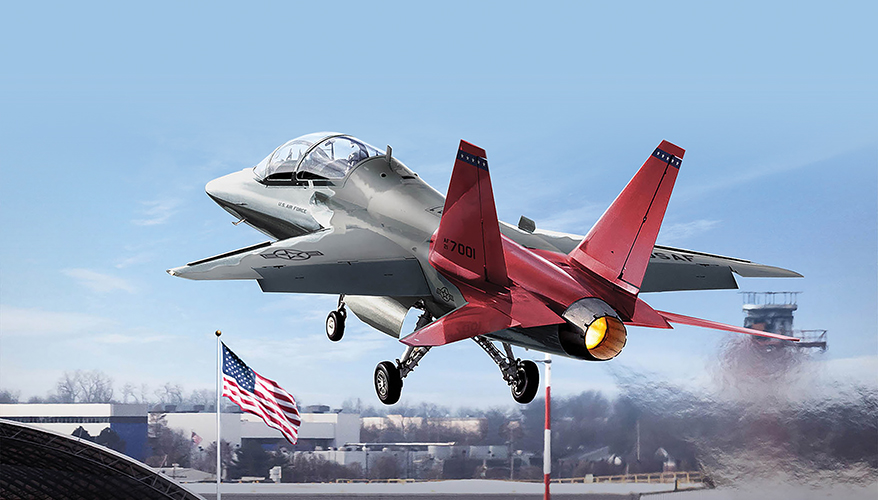 A T-7A Red Hawk takes off from St. Louis Lambert International Airport.
Boeing photo
This is part one of a two part story on the Boeing-Saab T-7A Red Hawk.
On May 12, a T-38 Talon II jet trainer assigned to Columbus Air Force Base in Mississippi crashed in western Alabama. Both pilots on board ejected safely, according to the base.
On May 19, the Air Force implemented a fleet-wide operational pause of all T-38 aircraft to allow the service’s safety board to locate and assess evidence from the mishap and ensure the “continued safety of Air Force personnel and equipment involved in flying T-38 operations while the investigation progresses,” a service release stated.
While the flight pause was lifted on May 28, it brought into sharp focus the need for the Boeing-Saab T-7A Red Hawk, the Air Force’s replacement for the 60-plus-year-old T-38. The service in April cleared the Red Hawk for production, eight years after initial contract award.
But as Boeing bends metal on the first 14 of a planned fleet of 351 aircraft, the Air Force is taking a wait-and-see approach with future T-7A lot buys as developmental testing continues.
The program has had its challenges and is a few years behind schedule, Program Executive Officer for Training Rodney Stevens acknowledged in an interview, and the pressing need to replace the aging T-38 led the Air Force to break from traditional acquisition processes to put it back on track.
Typically, the service would complete all necessary developmental testing “to get you to a point where you’re ready for a low-rate initial production decision,” Stevens said. But if the Air Force had done that with Red Hawk, it would have experienced even further delays, he added.
Instead, the service is taking a “concurrent development approach where we were willing to start producing aircraft … all while we’re still going through developmental testing,” he said.
This approach also worked for the Red Hawk’s future users at Air Education and Training Command, said Brig. Gen. Matthew Leard, the command’s director of plans, programs, requirements and international affairs.
“From an operational perspective, we said, well, if we’re already at [a] capability that is roughly equivalent to a T-38 — and in certain areas exceeds the capability of the T-38 — why would we delay? Why would we delay and wait for a capability that is great and that we want, but we don’t need right now? We need [to replace] the T-38 right now,” Leard said during the interview.
By buying T-7As before completing developmental testing, “we’ve already got a year and a half or two years worth of training maintenance, training instructors, and so that’s a year, year and a half that we’re closer to training our first student pilots versus waiting for the full airplane and then starting that whole build-up,” he said.
Along with the first production lot of 14 T-7As that the Air Force committed to in April, the service already has two production-representative aircraft in use with the 99th Flying Training Squadron at Randolph Air Force Base in Texas, and it will start receiving four production-representative test vehicles this summer, Stevens said.
Those production-representative test vehicles allow the Air Force to begin pilot proficiency training leading up to initial operational test and evaluation, all while the service continues developmental testing, he said.
The first aircraft from the initial production lot will be delivered in the spring of 2027, with the 14th and final aircraft in that lot arriving in the winter of 2028, he added.
The T-7A program office will then seek approval for the next two low-rate initial production lots individually to manage concurrency risk by incorporating insights from ongoing developmental testing and other program progress before committing to those subsequent lots, an Air Force release stated.
As the engineering and manufacturing development phase of the program continues, the Air Force is conducting testing in areas such as software and system integration — including the embedded training capabilities, simulators and ground-based training systems — and evaluating “certain performance parameters” such as how many Gs the aircraft can sustain and its angle of attack, Stevens said.
To evaluate airworthiness, the Air Force has a scorecard broken down by each lot, he said. “It relates to performance, it relates to airworthiness, relates to reliability and logistics, all the things that you anticipate that need to be in place as we continue to build the number of aircraft that are in the Air Force inventory to be able to be safely operated.”
The Air Force has established decision points where it can be precise about the number of aircraft it buys in each lot, he said. The program office will convene with the service acquisition executive in the spring of 2027 to evaluate the aircraft’s progress and how many Red Hawks it will buy in the second production lot, and then repeat the process for the third production lot in the first quarter of 2028.
There are ranges for the lot buys that it has structured to the contract depending on “where we stand from a budgetary perspective,” he said. And if an issue is discovered during engineering and manufacturing development, “we have the opportunity to pause and not exercise a lot buy in totality up to what the president’s budget is, so we can always perhaps do something less or none at all.” The Air Force’s 2027 budget request calls for purchasing 23 Red Hawks in the second production lot, he noted.
Heather Penney, director of studies and research at the Mitchell Institute for Aerospace Studies, said in an interview the Air Force is hedging its risk by not going full bore on those low-rate initial production jets.
There are some discoveries made through the operation of a new aircraft, “whether or not that has to do with what we call infant mortality — so, parts and pieces that were expected to live a lot longer or be far more robust end up demonstrating that they’ve got some quirks or some issues that need to be addressed” — or minor design issues, she said.
“Low-rate initial production is often not the complete done deal, so there might be some changes between that low-rate initial production, including quality issues, before you begin to get into the subsequent lots,” she said.
While managing risk for the initial T-7A production lots makes sense, “the government should absolutely lean into doing a large production, multi-year contract as soon as they possibly can get to that kind of production stability,” Penney said.
A multi-year contract not only provides the government cost savings but also increases supply chain stability, she said. “It’s [continuing resolution] proof, it’s politics proof.”
The Red Hawk is a “national security need when it comes to combat pilots, so we shouldn’t be leaving that up to the vicissitudes of politics on the Hill. Multi-year production is going to be something the Air Force needs to lean into as soon as they can,” she added.
Leard noted that along with the Air Force’s pressing need for the Red Hawk, there is demand “inside the Joint Force and inside coalition [forces] for a capability that is a lot like the T-7.”
Richard Aboulafia, managing director at AeroDynamic Advisory, said the Red Hawk program has “always had a pretty aggressive plan for export sales. My problem has been that the market for high-end supersonic trainers abroad has always been dismal.” The T-38 primarily went abroad as part of foreign military aid rather than sales, he noted in an interview.
Additionally, the T-7A might be the “first test of the collapse of trust in the U.S. as an ally,” he said. While certain NATO allies, Australia, Canada and Japan might hold interest in the aircraft, “a lot of countries are going to think twice about procuring U.S. equipment.”
That said, there has been progress in the high-end jet trainer market, he added. Korea Aerospace Industries and Lockheed Martin have found buyers for their T-50 Golden Eagle aircraft, he noted.
The T-7A will probably generate some sales as well, he said. “I don’t think it will be more than one or two per month, but not nothing.”
A Boeing spokesperson said in an email that there is “high global interest” in the Red Hawk, “but our top priority remains meeting U.S. Air Force commitments first.”
Stevens said the Air Force has not yet received any formal requests from foreign allies for the Red Hawk. “Our main focus is to ruthlessly execute and deliver the T-7s to AETC, and we are keenly focused in on that.”
Nevertheless, the service is “posturing to ensure that we are able to respond to any particular foreign military sales requests that come in [for] the aircraft.” There’s a lot of interest, but countries are waiting to see how things progress with regards to making it through developmental testing and ramping up production, and then building off from there, he said.
The T-7A Red Hawk is not “out of the woods by any means,” Stevens said, but added that he is confident the program can overcome any challenges that come up from here and achieve the Air Force’s goal of initial operational capability by 2027.
While achieving initial operational capability on time is crucial, the “most important milestone … is the first student pilot that the instructor pilots are going to train in the 2028 timeframe,” he said. “While we’re charging to IOC, we can’t lose sight of that first class that’s going to go through the T-7, and that’s really what our North Star is.”