
TRAINING AND SIMULATION
JUST IN: Global Tensions Fueling Training and Simulation Market, Report Says
iStock photo
Heightened geopolitical tensions have reinforced the importance of readiness and modernization, fueling a growth in the training and simulation sector amid increased defense spending and evolving military strategies, a June 2 report found.
Financial firm Capstone Partners released the report “Modern Defense Readiness Priorities Fuel Training and Simulation Sector Momentum,” tracking the increase in federal spending for military readiness and modernization initiatives since fiscal year 2020, and the numbers reflect a fruitful environment for training and simulation solutions.
The report tracked an increase in federal spending each year since 2020, going from $718.4 billion to $961.6 billion in 2026, with the fiscal year 2027 defense budget request representing a 44 percent increase that would eclipse $1.45 trillion in spending.
“The scale of the proposed budget underscores the immediate demands of the unstable geopolitical landscape and the requirement of investment for future risk mitigation preparedness,” the report said. As geopolitical tensions heighten, pressure is mounting for military readiness efforts and driving demand for training and simulation solutions.
As a result, the Pentagon increased training investments by 7.8 percent for 2026, allocating $159.7 billion towards military readiness, according to the Defense Department's fiscal year 2026 budget request cited in the report.
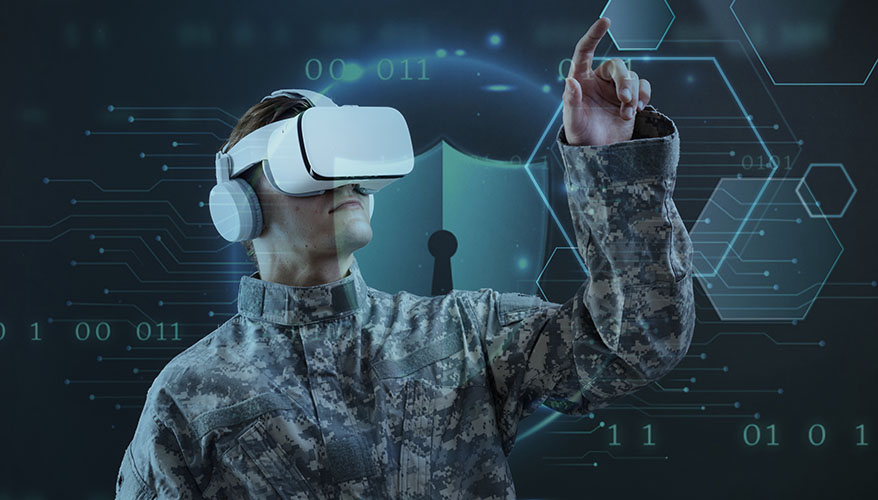
Traditional warfare strategies and methodologies have remained foundational to military training but the pace and complexity of modern conflicts have challenged the scalability and efficiency of conventional models, it said. In response, militaries have increasingly turned to virtually enabled readiness solutions to supplement live training exercises.
“Increased prioritization of digital applications has allowed teams to rehearse complex, multi-domain scenarios with greater frequency, flexibility and realism while reducing reliance on physical infrastructure, personnel development and resource-intensive exercises,” the report said.
This shift has created a favorable demand environment for training and simulation sector participants as defense organizations seek scalable, software-driven solutions with agile modification capabilities to reflect evolving threat conditions, according to the report.
Financial performance of scaled providers reflects notable revenue increases and that training and simulation sector operators offering immersive, modular solutions at scale have “increasingly attracted buyer interest” as acquirers seek to consolidate capabilities and access digital training platforms, the report said.
The report also found a 45.7 percent increase in training and simulation sector dealmaking in 2025 — tailwinds that have “continued to drive [mergers and acquisitions] momentum,” with 2026 volume rising 133.3 percent.
Of note, Anduril Industries announced its acquisition of ExoAnalytic Solutions — a provider of U.S. military modeling and simulation solutions — in March 2026 for an undisclosed amount.
Capstone expects outsized training and simulation sector mergers and acquisitions activity to persist through 2026 as military modernization and differentiated training will likely propel buyer interest in businesses with innovative and critical applications, according to the report.
Additionally, Capstone Partners tracked renewed private equity activity supporting training and simulation mergers and acquisitions since 2020. The numbers have fluctuated, but most recently the number of transactions per buyer has increased from 40 in 2024 to 59 in 2025.
Military and government contracts have served as a “key catalyst” for dealmaking within the training and simulation sector as warfighter readiness has continued to turn digital. Additionally, federal funding, security requirements and operation integration have helped incentivized customers into the playbook of the market.
Scott Schneider, CEO of defense technology company HTX Labs, said in the report that the company’s opportunities with the Air Force and the Scalable Homeland Innovation Enterprise Layered Defense program have provided a “prime opportunity” to continue a transition toward “standardized, platform-based training environments that can scale across commands, aircraft and mission sets.”
Additionally, there is a “strong alignment” around reducing training variability, improving readiness and enabling more efficient use of resources, Schneider said. “As defense systems become more interconnected and multi-domain in nature, the need for scalable training and mission rehearsal environments increases significantly.”